K-Now?
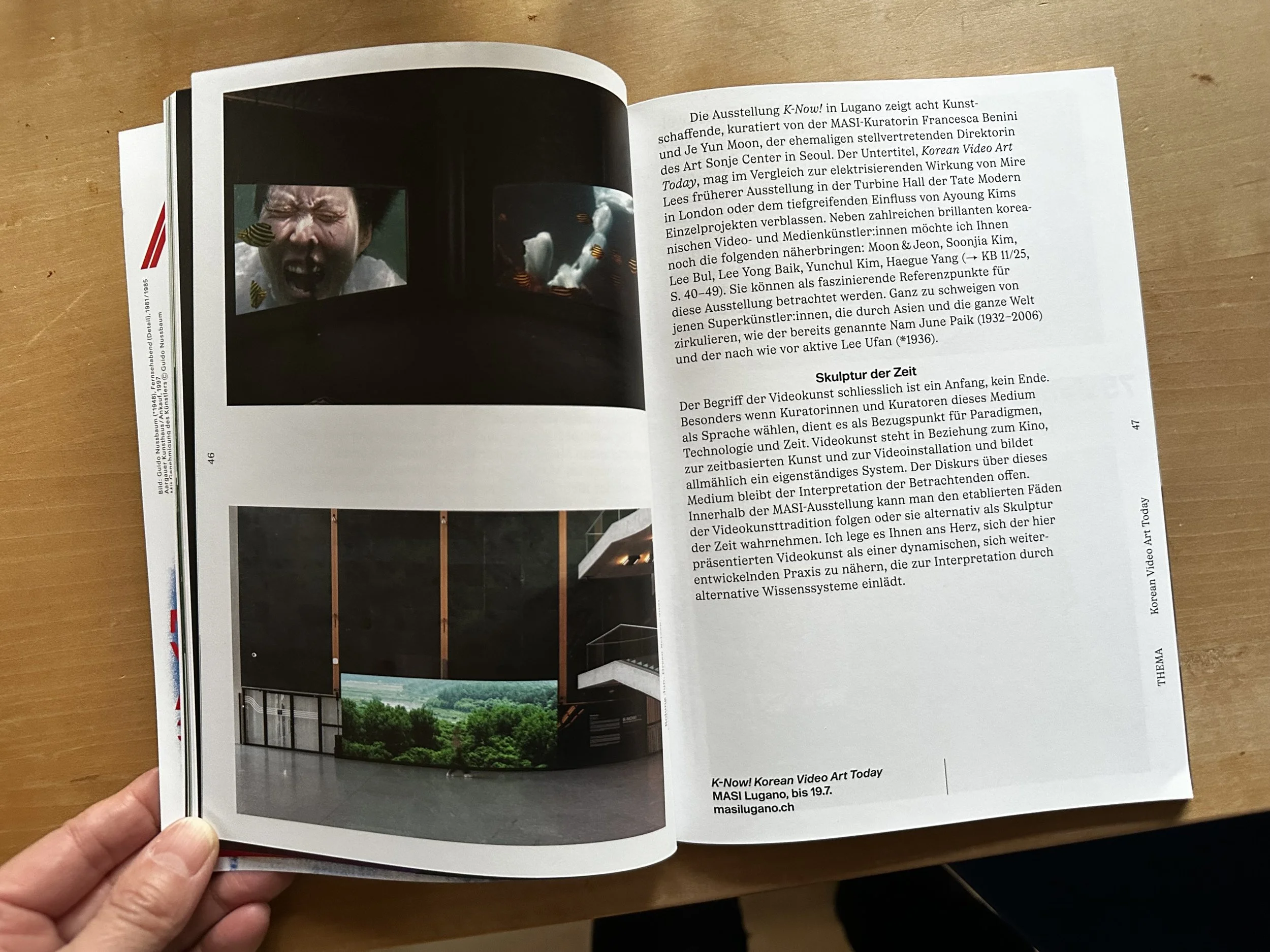
MASI美术馆进门大厅左手就是Sojung Jun的作品Green Screen,顺着楼梯向下负二层,进门是Chan-Kyong Park三屏幕的作品Citizen’s Forest,继续从左上角进入下一个空间,Ayoung Kim的作品Delivery Dancer’s Sphere成为这一开敞展厅的中心,左手Onejoon Che的Made in Korea,右手Sungsil Ryu的<BJ Cherry Jang 2018.9>,及其旁边的Heecheon Kim的Ghost1990,右上角是업체eobchae的ROLA ROLLS,然后再进入到左手的Jane Jin Kaisen的Offering与Wrechage的双屏幕空间。
如何看策展人提出的录像艺术作为其最终展览的焦点,如何看策展人提出的录像从公共权力到艺术的进程?如何理解南韩文化的全球热潮?如何在亚洲的语境中看南韩的传统与现代?如何看新媒介的平等性?如何看异化的符号?在这些问题之后,才是你能否从作品中看到自己,也就是来自南韩的艺术家想要给予的“对人及其历史背景的观察”、“来自不同地缘人群的历史和现在”、“自我的觉醒”、“科技及人的异化”等线索。
录像艺术这一词汇的构建者,离不开已故的韩国艺术家Namjun Paik,其媒介所包容的行为、记录、叙事,以及呈现上的单屏幕、多屏幕、装置化和沉浸式等等。录像艺术在今天,如何扩展为三维化的,ai介入的,以及更高新科技带来的体验,都在延展着这一理念。
K展览以Sojung Jun的Green Screen所讨论的南北韩为开端,以Jane Jin Kaisend的Offering和Wrechage中的美军历史历史旧影为结尾,从这一线索看,展览是非常政治性的,悬而未决的南北韩问题,持续发酵的美国影响,是这个展览,乃至韩国文化的边界。
悬而未决的困境,家人分离的现实。只有深陷其中,才能体会其痛苦。美国,及其文化也构成这一现实的底色,美军基地和反美运动,是一个硬币的两面,同样出现在诸多亚洲国家的现实中,如何理解存在的悖论,也是观看这个展览的入口之一。
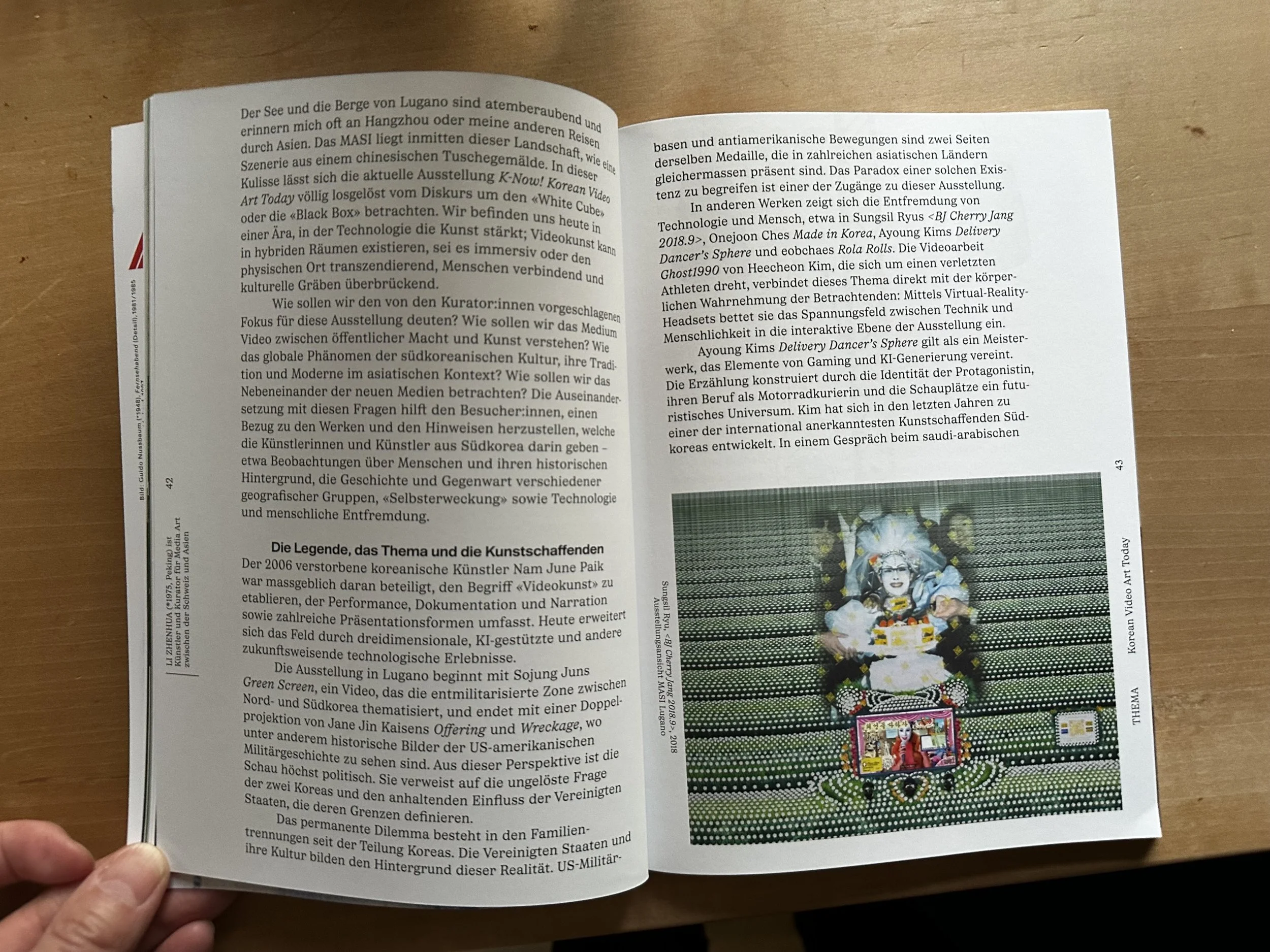
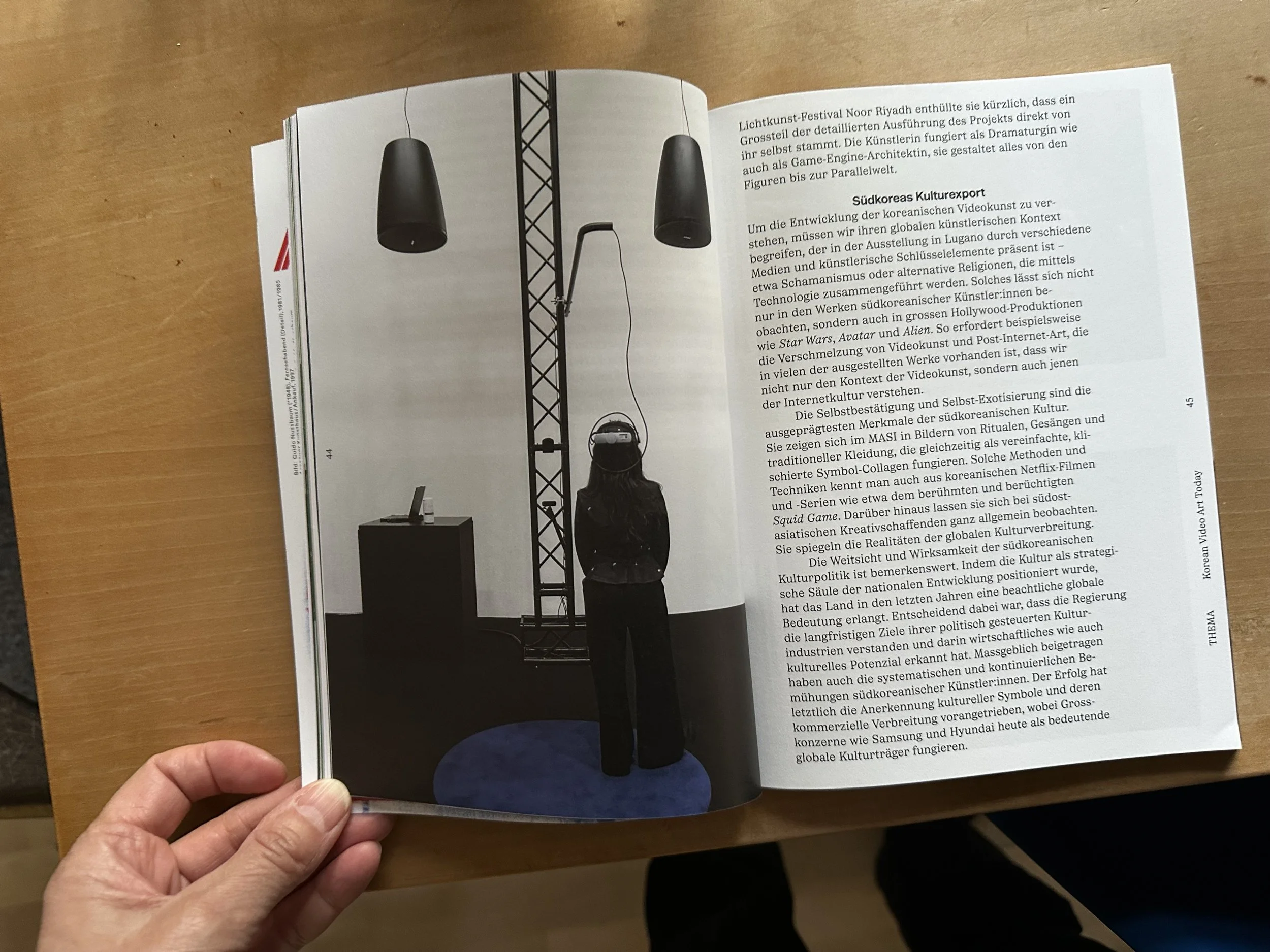
科技和人的异化,在其他作品中都有显现,如文化流动性带来的认知差,在Sungsil Ryu的<BJ Cherry Jang 2018.9>中,在Onejoon Che的Made in Korea中,在Ayoung Kim的Delivery Dancer's Sphere中,也在업체eobchae的ROLA ROLLS中,而Heecheon Kim的Ghost1990把这一主线,直接与观者的身体感知链接,通过头显和三维空间,直接将科技和人的异化内嵌在现场的观众互动环节。
Ayoung Kim的Delivery Dancer's Sphere是集大成者,涉及到游戏,ai生成,其剧本从主角的身份、职业、场景,构建了一个Delivery Dancer's Sphere宇宙。Ayoung Kim是这几年最闪耀国际的韩国艺术家,而在不久前Noor Riyadh的对谈中,她也说到了项目中的很多具体执行工作都来自她本人。艺术家也是剧作者,还是游戏引擎的使用者。从人物造型到异世界设定。
录像的艺术的指向及其延伸,需要我们从不同的媒介和艺术关键词去理解展览所能同步的全球艺术语境,如萨满、另类宗教和科技融合的特征,不仅仅在南韩艺术家的工作中,也在好莱坞电影《星球大战》《阿凡达》《异形》等等线索中;如录像艺术和后网络艺术的融合,如何更好的认识艺术家及其创作的切入点,有着录像艺术的上文,也需要有网络文化的下文,这才能让我们更好的去看来自南韩艺术家的创作。
录像艺术是开始,不是终结。尤其在策展人选择这个媒介语言之初,这是一个范围、技术和时间的指涉。如录像艺术与电影,录像艺术与基于时间的艺术,录像艺术空间化等等,录像艺术也在逐步构成另一个体系。媒介论述还有待观者揭示,在此展览中,即可以按照录像艺术传统的线索去观看,也可以将其看作时间的雕塑。但请将这个展览提出的录像艺术,看作是动态发展中的,试着尝试用另外的知识去解释。
文化的自我确认及其自我他者化,这是南韩文化最大的普遍性特征,如仪式、唱诵和传统服饰带来的身份确认,也是符号化的简化拼贴,也是自我他者化的策略,其手段和方法,在Netflix的韩国电影与剧集中,可见一斑。这不仅仅是南韩艺术家的策略,也是现在东南亚艺术家的成功策略,同样映射着来自全球文化传播的现实,如何认识母体文化,从研究系统入手肯定是更有效的,但这些系统本身带来的文化偏见,就是最好的例证。我们什么时候在用类似的眼光看待自己的?以及什么时候开始需要这样的符号化的自己?是值得思考的问题,即在社会认识和更准确嵌套文化符号,也就自然的让人可能被纳入到系统性的认知中,即我们有同样的世界观和价值观,可以彼此交流。而这一前提的弊端是,我们必须交流那些认知内的陈词滥调,或被媒体化统合的部分,才被认为是合理的,如同一个合理的剧本对白,这也正在真实生活中不断重复上演。也许,我们可能从每个具体的个人去感知他人,而不是综合为一种浅表的归类化、概念化解释。
K展有8位艺术家,来自MASI的策展人和南韩策展人,其副标题“今日韩国录像艺术”,也许远远不如之前Mira Lee在TATE Modern涡轮大厅的刺激感和力量感,也不如这个展览中Ayoung Kim的其他个展项目的深远影响。以及你需要知道的众多闪亮的韩国录像和媒体艺术家们:Moon & Joen, Soonjia Kim, Lee Bul, Lee Yong Baik, Yunchul Kim, Haegue Yang等等,作为这个展览有趣的参照。还有那些在亚洲和全球流动的超级艺术家,如已故的Nam June Baik,以及至今依然活跃的Lee Ufan。
在瑞士很少能看到这样的展览,在这个时代还有很多类似的文化交流,早已不复存在。这里不得不提到南韩文化政策的前瞻性和有效性,文化作为其国家发展的策略,近几年来大放异彩,全球通吃,关键还是政府懂得政策所推动的文化产业,及其经济和文化影响下的长远目标,也与其目标中的实际收益相符,也是南韩艺术工作者能有系统、有策略、有创造性,长期努力的结果。也最终带动了可识别的文化符号及其商业循环,其中三星和现代等超级企业,也已经是全球文化运作的超级推动者。
请原谅我对韩国艺术领域及其艺术工作者的粗浅判断,在如今的技术主导的语境下,还有众多未能被发掘的伟大艺术家,她们散落在过去的艺术活动中,以及今天的社群媒体世界。在一些地缘和文化知识上的补充,我建议您去了解一下南北韩是如何产生的。韩国、日本和中国的联系。在美国和欧洲的韩国移民历史。K-Pop和K-Culture的影响力。
K-Now?
Entering the MASI Lugano hall. On the left is Sojung Jun's work Green Screen. Descend the stairs to the second basement level, where you will find Chan-Kyong Park's three-channel projection work Citizen's Forest. Continue to the next space in the upper left corner, where Ayoung Kim's work Delivery Dancer's Sphere takes centre stage in this open exhibition hall. On the left is Onejoon Che's Made in Korea, on the right is Sungsil Ryu's <BJ Cherry Jang 2018.9>, and next to it is Heecheon Kim's Ghost1990. In the upper right corner is 업체eobchae's ROLA ROLLS, and then you enter the dual-screen space of Jane Jin Kaisen's Offering and Wrechage on the left.
How should we view the curator's proposed video art as the focus of the final exhibition? How should we view the process of video art proposed by the curator, from public power to art? How should we understand the global phenomenon of South Korean culture? How should we view South Korean tradition and modernity in the Asian context? How should we view the equality of new media? How should we view the symbols of alienation? Only after considering these questions can you see yourself in the works, namely the clues that artists from South Korea want to give, such as ‘observations of people and their historical background’, ‘the history and present of different geographical groups’, ‘self-awakening’, and ‘technology and human alienation’.
The late Korean artist Nam June Paik was instrumental in establishing the term ‘video art,’ which encompasses performance, documentation, narrative, and presentation formats such as single-channel, multi-channel, installation, and immersive. Today, video art continues to expand this concept through three-dimensional, AI-assisted, and other cutting-edge technological experiences.
The exhibition begins with Sojung Jun's Green Screen, which discusses North and South Korea, and ends with Jane Jin Kaisend's Offering and Wrechage, which features old images of US military history. From this perspective, the exhibition is highly political, with the unresolved issue of North and South Korea and the continuing influence of the United States defining its boundaries, even those of Korean culture.
The unresolved predicament, the reality of family separation. Only those immersed in it can truly grasp its anguish. America, and its culture, form the backdrop to this reality. US military bases and anti-American movements are two sides of the same coin, equally present in the realities of numerous Asian nations. Understanding the paradox of existence is one of the entry points to viewing this exhibition.
The alienation of technology and people is evident in other works, such as the cognitive differences brought about by cultural fluidity in Sungsil Ryu's <BJ Cherry Jang 2018. 9, Onejoon Che's Made in Korea, Ayoung Kim's Delivery Dancer's Sphere, and eobchae's ROLA ROLLS. Heecheon Kim's Ghost1990 directly links this theme to the viewer's physical perception, embedding the alienation of technology and humanity in the interactive element of the exhibition through virtual reality headsets and three-dimensional space.
Ayoung Kim's Delivery Dancer's Sphere stands as a magnum opus, converging elements of gaming and AI generation. Its narrative constructs the Delivery Dancer's Sphere universe through the protagonist's identity, profession, and settings. Kim has emerged as one of South Korea's most internationally acclaimed artists in recent years. In a recent dialogue at Noor Riyadh, she revealed that much of the project's detailed execution emanated directly from her own hands. The artist serves as both playwright and game engine architect, from character design to alternate-world setting.
The direction of video art and its extension requires us to understand the global artistic context that the exhibition can synchronise with through different media and artistic keywords, such as the characteristics of shamanism, alternative religion and technological fusion, not only in the work of South Korean artists, but also in major Hollywood films such as Star Wars, Avatar and Alien. For example, the fusion of video art and post-internet art requires not only the context of video art but also that of internet culture, so that we can better appreciate the work of South Korean artists.
The concept of video art is a beginning, not an end. Particularly when curators first select this medium as a language, it serves as a reference point for paradigms, technology, and time. Video art relates to cinema, to time-based art, and to video art installation, gradually forming another system. The discourse on this medium remains open to interpretation by the viewer. Within this exhibition, one may follow the established threads of video art tradition, or alternatively perceive it as a sculpture of time. Yet, please approach the video art presented here as a dynamic, evolving practice, inviting interpretation through alternative frameworks of knowledge.
The self-affirmation of culture and its self-othering constitute the most pervasive characteristic of South Korean culture. This manifests as identity confirmation through rituals, chants, and traditional attire, yet simultaneously functions as a simplified collage of symbols and a strategy for self-othering. Its methods and techniques are readily observable in Netflix's Korean films and TV series. This approach is not exclusive to South Korean artists; it has also proven successful for Southeast Asian creative practitioners. It mirrors the realities of global cultural dissemination. While examining the research systems underpinning these approaches offers valuable insights into root cultures, the inherent cultural biases within these systems themselves constitute the most compelling evidence. When do we adopt similar perspectives towards our own cultures? And when did we begin requiring such symbolic representations of ourselves? These are questions worthy of reflection. By recognising societal frameworks and more accurately embedding cultural symbols, individuals naturally become integrated into systemic cognition – sharing common worldviews and values that facilitate mutual exchange. The pitfall of this premise is that we must exchange clichés within these shared frameworks, or media-consolidated fragments, to be deemed legitimate – much like scripted dialogue in a well-crafted play. This very scenario plays out repeatedly in real life. Perhaps we should perceive others through each individual's unique essence, rather than reducing them to superficial categorisations and conceptualised interpretations.
The K-NOW Exhibition features eight artists: Chan-kyong Park, Jane Jin Kaisen, Ayoung Kim, 업체eobchae, Sungsil Ryu, Heecheon Kim, Onejoon Che and Sojung Jun. Curated by MASI curator Francesca Benini and South Korean curator Je Yun Moon. Its subtitle, ‘Contemporary Korean Video Art,’ may pale in comparison to the electrifying impact of Mire Lee's previous exhibition in Tate Modern's Turbine Hall, or the profound influence of Ayoung Kim's other solo projects within this show. Alongside numerous brilliant Korean video and media artists you might wish to know: Moon & Jeon, Soonjia Kim, Lee Bul, Lee Yong Baik, Yunchul Kim, Haegue Yang and many others, serving as fascinating points of reference for this exhibition. Not to mention those super-artists circulating across Asia and the globe, such as the departed Nam June Paik and the perpetually active Lee Ufan.
Yet such exhibitions remain rare in Switzerland, where many similar cultural exchanges have long since vanished in this era. One must acknowledge the foresight and effectiveness of South Korea's cultural policy. By positioning culture as a strategic pillar of national development, the nation has achieved remarkable global prominence in recent years. Crucially, the government understands the long-term objectives of its policy-driven cultural industries, recognising both their economic and cultural impacts and the tangible returns. This success stems from the systematic, strategic, and creative sustained efforts of South Korean artists. This has ultimately driven the recognition of cultural symbols and their commercial circulation, with super-enterprises such as Samsung and Hyundai now serving as major global cultural drivers.
* Please forgive my rudimentary understanding of the Korean art sphere and its practitioners. Within today's technology-dominated context, numerous great artists remain undiscovered, scattered across past artistic endeavours and today's social media landscape. For supplementary geographical and cultural context, I recommend exploring: - The origins of North and South Korea - Connections between Korea, Japan, and China - The history of Korean immigration to the United States and Europe The influence of K-Pop and K-Culture. And do try to engage in a quiet conversation with a Korean cultural practitioner.
References
1. https://en.wikipedia.org/wiki/Pachinko_(TV_series)
2. https://en.wikipedia.org/wiki/A_Taxi_Driver
3. https://en.wikipedia.org/wiki/The_Man_Standing_Next
4. https://en.wikipedia.org/wiki/Mono-ha
5. https://en.wikipedia.org/wiki/Nam_June_Paik
6. https://mediacityseoul.kr/en/today
7. https://en.wikipedia.org/wiki/Byung-Chul_Han
10. https://www.e-flux.com/search?q=korean%20contemporary%20art
11. https://www.nabi.or.kr/en/page/about/history.php
12. https://www.e-flux.com/directory/368546/alternative-space-loop