
NOOR RIYADH 2025
In the Blink of an Eye illuminates Noor Riyadh 2025, casting a vibrant constellation of light art across the city’s heart and along the sleek, modern lines of its new metro system.
This edition of the festival celebrates Riyadh’s rapid transformation. Its embrace of science, technology, and innovation. The narrative unfolds in two interwoven paths: in the historic center, light-based artworks converse with ancient architecture, bridging the city’s rich cultural heritage with its energetic present. In contrast, the metro stations radiate a pulse of modernity, animated by installations that reflect the pace and rhythm of urban life.
Light, evocative of movement and speed, serves as both medium and message in this year’s edition of Noor Riyadh. Kinetic sculptures and responsive installations trace the flow of people, visualizing connectivity and interaction. This year’s bold works capture Riyadh’s spirit of continuous transformation, embodying a city that is constantly in motion.
The festival invites visitors on a journey between eras, a place where tradition meets transformation. It is a metaphor for Riyadh’s broader trajectory: honoring the past while fearlessly looking ahead. Artists from around the world push the boundaries of light, using cutting-edge technology to spark reflection on the relationship between humanity, innovation, and urban change.
In the Blink of an Eye celebrates Riyadh
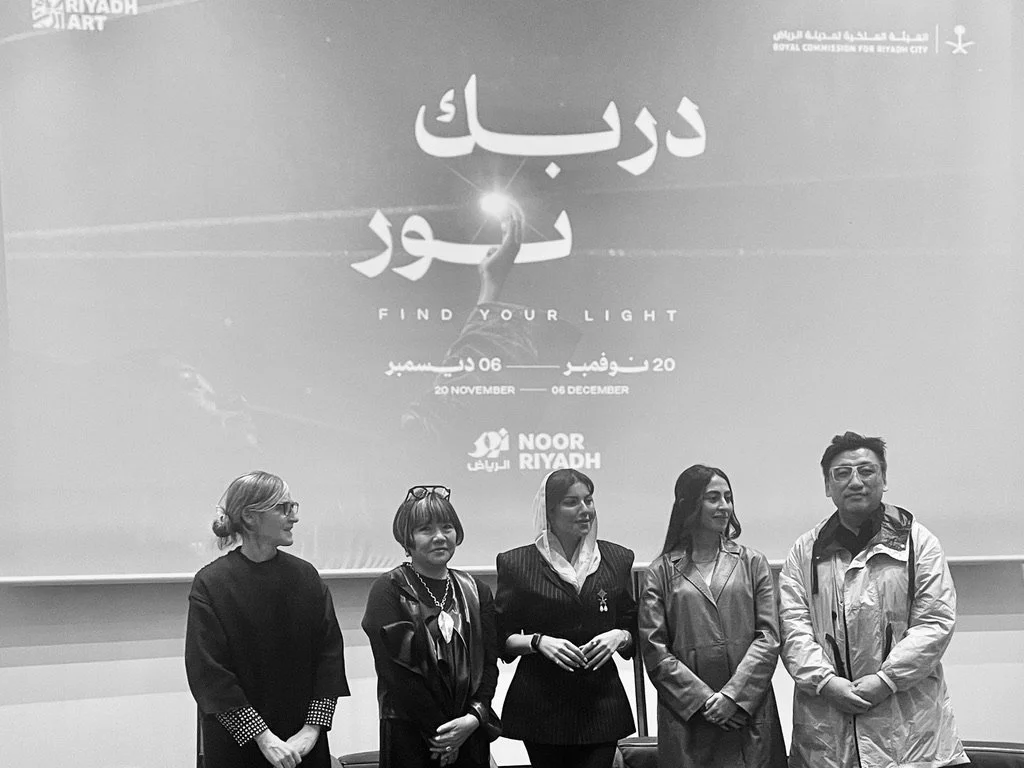
Sparkling glint of Noor Riyadh 2025 in Venice
Fondazione Querini Stampalia
19 Oct – 23 Nov 2025
Noor Riyadh and the Fondazione Querini Stampalia present a capsule exhibition during the Venice Architecture Biennale, offering an international preview of the upcoming Noor Riyadh Festival 2025, the world’s largest light art festival.
The exhibition is curated under the theme “In the Blink of an Eye” and reflects the pace of change in Riyadh as well as the growing role of cultural development in the city’s transformation. The capsule exhibition is curated by Li Zhenhua and Sara Almutlaq, with the support of this year’s festival Curatorial Advisory Lead, Mami Kataoka.
The exhibition is installed in the spaces designed by Carlo Scarpa at the Fondazione Querini Stampalia. Scarpa’s architectural intervention, which accommodates Venice’s periodic flooding, provides a distinct context for the presentation. In parallel, Noor Riyadh 2025 emphasizes the city’s current transformation and its ambition to serve as a global platform for artistic and cultural exchange.
In the blink of an eye
by Li Zhenhua
Light is both an interface and the messenger of how we perceive the world. Imagine a world without light, imagine the agony of not being able to see things, and the incompleteness brought about by the absence of sight.
Light, too, is visible or invisible, accessible or beyond reach. Just as the eye requires gradual adaptation to specific environments, light may also convey messages from others or describe indescribable sensations—an aura.
Light also serves as a metaphor for beauty in poetry and literature.
In today's world of digital fragmentation, information silos, polarisation, and cross-cultural realities, In the blink of an eye represents not merely the rapid capture of change, but acceptance and empowerment. As in Kobayashi Issa's haiku: ‘The world is as fleeting as a dewdrop, yet, yet...’ If the ancient attitude towards change reflected a resigned melancholy born of understanding the world's unalterable nature, what aspects of today's world remain within our grasp? Technology, velocity, fluidity, the extension and expansion of body and mind—perhaps it is time to ask how we might anchor our spiritual and inner peace, and our sense of self, within this environment of rapid development and consumption.
In the hyper-accelerated future, people will continue to rush frantically through Riyadh's metro. Shall we extend ourselves through AI, machinery, and biotechnology? Or retreat to deserts, jungles, and oceans, living reclusively as our ancestors did? Beyond these two stark extremes lies the option of space migration. Where will humanity ultimately head? What will become of our destiny? This is a universal question, yet it concerns each individual—how we coexist amidst modernity's onslaught.
How to find moments of tranquillity amidst the pressures of technology and humanity. How to “Love Difference” (Michelangelo Pistoletto), how to dream of the moon (Luna Somnium, FUSE), how to hover on a “flying carpet” (Rejane Cantoni), how to become entranced in the “Liminal Air” (Shinji Ohmaki). How to discover overlooked and forgotten cultures and people within the works of numerous Saudi artists. How to perceive the colossal transformations of cities and eras in the blink of an eye.
The individual exists both within and beyond this framework of destiny.
In the blink of an eye, it represents a temporal dimension, an outward action triggered by the human body. From an individual's perspective, it responds to external upheaval – simultaneously a unified whole and two separate events.
Do AI and machines blink? Do they dream? Do they possess emotion?
The exhibition's exploration of light, grounded in myriad clues, concerns technology, materials, and architecture, yet equally pertains to personal sentiment and perception. It represents the intricate progression of knowledge and practice.
Humans perceive the world, discover images and language, and then attempt to describe all things. They identify similarities and patterns, continuing their exploration. Subsequently, they synthesise this knowledge, discovering divinity and self. Then they invent narratives and stories, creating new, multidimensional, and super-organisations.
This mirrors the exhibition's diversity: exploring machines and humanity, the interplay between architecture's interior and exterior, wind, temperature, humidity, and visibility; examining interaction, community, materials, tradition, imagination, illusion, accessibility and possibility. Everything lies within the clues, some at the very edge of what is possible—a task potentially accomplished. Yet beyond the potential, the exhibition also prompts reflection on the impossible: where do human emotions find solace? How does humanity confront change? What future shall humanity embrace?
From the Red Sea to Mecca, Medina, then carried by the energy of wind and earth to Riyadh, civilisation emerged from the ocean, taking root upon the land. Civilisation is fluid; through mutual influence, how we perceive past origins shapes how we connect and journey together towards a better future. Perhaps this is Light The Way Home (Zhang Zengzeng), Light, Floating Down Like a Feather (Wang Yuyang), or The Uploader (Zheng Da)—metaphors and love conveyed through art, a close observation of every civilisation, determining the possibilities of life's diversity. Humankind is not merely evolution's servant, nor should we be mere ‘users’ in today's technocratic world. In the blink of an eye is both an homage to our rapidly evolving world and a hymn of humanity and time.
In the blink of an eye, I shall sketch the panorama with metro lines. I recommend leisurely visits to Al Faisaliah tower, KAFD, STC, the National Museum (KAHC), and Qasr Al-Hukm Palace, followed by a day exploring JAX to experience the allure of Ayoung Kim and Saudi art scene. Whether travelling by metro, car or on foot, savour the delights of the Noor Riyadh 2025 Festival.
一眨眼 in the blink of an eye
(文)李振华
光,即是界面,也是我们如何看待世界的使者,想象一个没有光的世界,想象一下不能看到事物的痛苦,以及因为没有视觉带来的不完整。
光,也有可见或不可见,也有可介入与不可介入。如眼睛需要在特殊环境慢慢适应的过程,光,也可能是来自他人的讯息,也可以是人形容不可描述的感受——光晕(AURA)。
光,也是人用在诗歌和文学中,对美好事物的比喻。
在今日世界,数字分离,信息茧房,两极化,跨文化的现实中,《一眨眼》正是相较于变化迅速的拾取,是接受和赋能。如小林一茶的俳句:“世界如露珠般短暂,然而,然而……”如果说古人面对变化的态度中无奈而哀伤的情绪,是对世界不可介入的理解。那么今天的世界又有哪些是可介入的?技术、速度、流动性,身体和大脑的延展、扩张,或许是时候问问自己,精神和内心的安宁,以及高速发展和消费的环境中之自我,如何安放。
人会在超高速的未来,在利雅得的地铁上,继续狂奔。让AI、机械、生物科技成为人的延伸?抑或是在沙漠中、丛林里、大海上,像古人一样,避世而居?两个完全不同的极端选择之外,还有向外太空移民的选项,人类会最终走向哪里?人类的命运最终如何?这是一个普世的问题,但也关乎每个人,人和人如何在现代性的冲击中相处。如何在技术和人的压迫中,找到片刻的安宁。如何“爱不同”(Pistoletto),如何有“月梦”(FUSE),如何在“飞毯”(Rejane Cantoni)上翱翔,如何在“临界之气”(Shinji Ohmaki,)中出神。如何在众多沙特艺术家的创作中,找到被忽略和遗忘的文化和人。如何《一眨眼》间,体会城市和时代巨变。
个体,在这一命运框架之中,也在之外。
一眨眼,是时间上的维度,是以人身触发的对外之动作,从一个人的角度,回应外在的巨变,即是统一的整体,也是分离的两件事。
AI、机器,会眨眼吗?会做梦吗?会有情感吗?
展览对光的探寻,基于众多线索,是关于技术、材料、建筑的,也是关于个人感情和感知的。是知识和实践的复杂递进。
人通过感受世界,发现图画和语言,然后试着描述世间万事万物,然后找到相似性及其规律,然后继续探索。然后,再将这些知识融会贯通,发现神,发现自我。然后,发明叙事和故事,创造新的,多维度的,超级组织结构。
这也如同展览的多样性,在探索机器与人,在探索建筑内外,在探索风、温湿度和可见度,在探索交互,在探索社群,在探索材料和传统,在探索想象力和幻觉,在探索可能性。一切都在线索中,一些也都在可能的极限中,一次可能完成的任务。而除了可能的,展览也在为不可能提出反思,人的情感如何安处?人如何面变化?人将走向哪一种未来?
从红海到麦加、麦地那,再到利雅得,文明来自海洋,在陆地落地生根,文明是流动的,在相互影响下,我们如何看待过去的起源,也会影响到我们如何彼此相连,如何一起走向更好的未来。也许这是《回家的路》(张增增),是《光像羽毛一样飘落》(王郁洋),是《上传者》(郑达),是艺术能够传递的额比喻和爱,是对每一处文明的细观,也决定着生命多样性之可能,人不仅仅是进化论的奴仆,也不应该是今天科技主导下的用户,《一眨眼》是对快速发展世界的赞颂,也是人和时间恒常之歌。
一眨眼,我将用地铁线路勾勒出这幅全景图。建议悠闲探访费萨利亚塔、KAFD、STC大厦、国家博物馆(KAHC)及卡斯尔·阿尔胡克姆宫,随后花一天时间探索JAX艺术区,感受金雅瑛(Ayoung Kim)与沙特艺术界的魅力。无论乘坐地铁、驾车或步行,尽情品味“诺尔利雅得2025”艺术节的精彩。